Scheduling Strategies for Concurrent Agent Tasks
Applying operating-system scheduling to prevent coordinated agent failures.

Multi-agent AI systems have a scheduling problem, and most teams building them don't know it yet. The center of gravity in agent engineering has shifted fast, from single-assistant loops that run one task at a time to coordinated systems with explicit routing, shared memory, and real governance overhead. Gartner's 2025 forecast put a number on how fast this is moving: up to 40% of enterprise applications will include task-specific AI agents by 2026, up from under 5% in 2025. That jump is not just adoption. It's a coordination problem arriving at scale, all at once, for teams that mostly haven't dealt with it before.
Something changes the moment a system moves from one agent to many. Agents start sharing resources none of them can see the others using. A failure in one now drags down the throughput and correctness of others nearby. And sequencing decisions that used to be implicit (which task runs first, which one waits) suddenly carry real weight, because getting them wrong means wasted spend or a request that silently fails.
The clearest way to think about this borrows straight from operating systems: the orchestrator is the scheduler, agents are processes, tool calls are system calls, and shared memory is the file system. That frame is the organizing lens for everything below. It's the organizing lens for everything below, because operating systems solved versions of this problem decades ago, and the primitives they built (admission control, priority queues, backpressure) turn out to map onto agent systems almost without modification.
What uncoordinated parallel agents fail on
The HiveMind research paper opens with a scenario that should be uncomfortably familiar to anyone running agents at scale: 11 concurrent Claude Code agents, sharing a single Anthropic API key, dispatched at the same time with no coordination between them. Three agents died. Two hit ECONNRESET, one hit an HTTP 502, for a 27% failure rate across the batch. The API had enough aggregate capacity to serve all 11 agents just fine, if they'd gone one after another instead of all at once.
The paper's own diagnosis is blunt. Staggering the requests by five seconds, just five seconds of spacing, would have saved every single agent from failing. That reframes the whole problem. It's a coordination failure, dressed up as an infrastructure failure, not a capacity shortfall or a rate-limit problem in the way most engineers assume. It's a coordination failure, dressed up as an infrastructure failure.
Four resources sit at the center of almost every contention scenario like this. API rate limits, covering both request counts and token throughput. Network connection limits, which cap how many sockets can stay open at once. Context windows, which are fixed no matter how many agents want to use them simultaneously. And API-key quotas, which govern billing and access and don't care how many processes are drawing against them at the same moment.
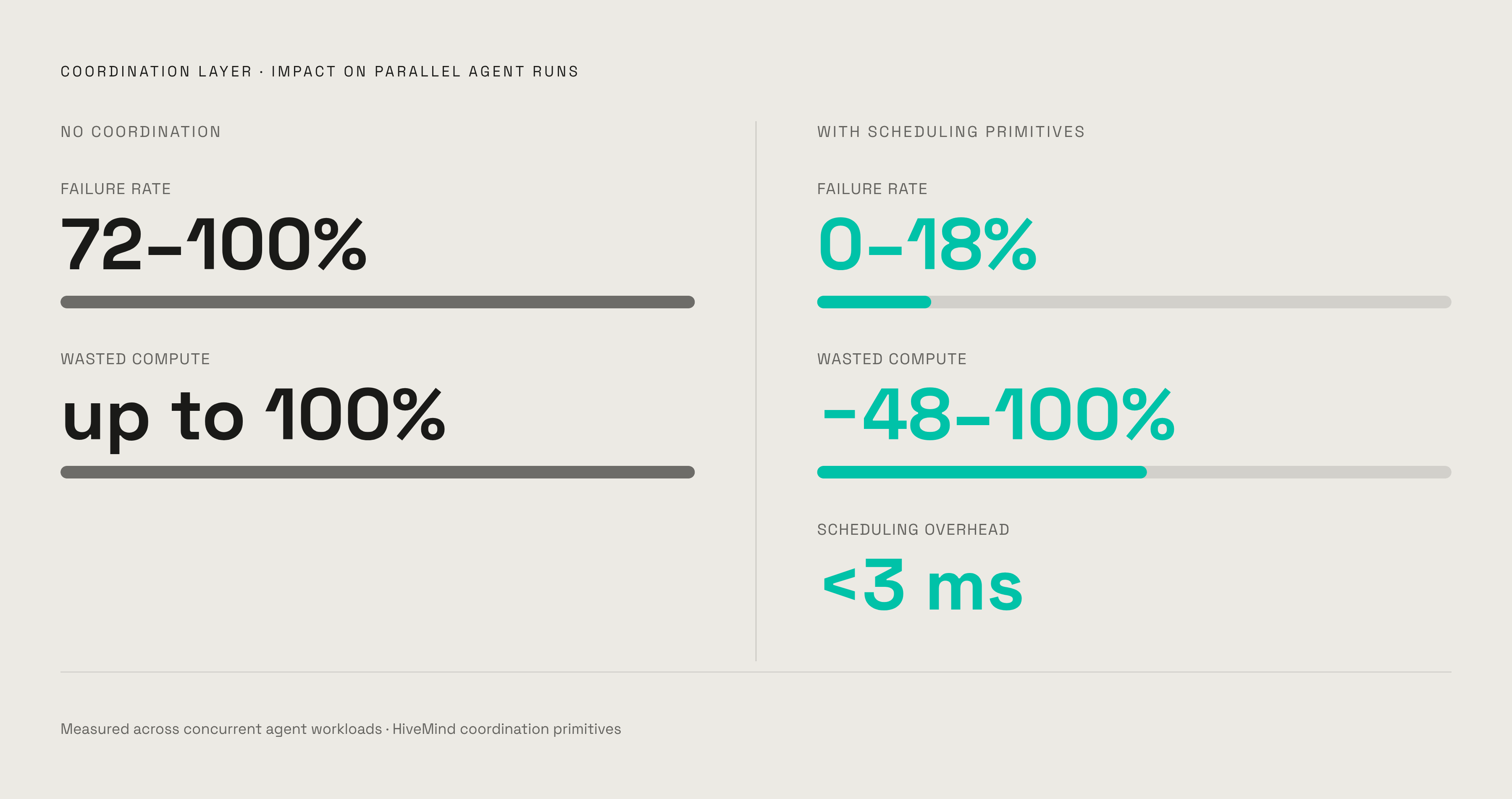
HiveMind's broader evaluation, run across seven scenarios ranging from 5 to 50 concurrent agents, found failure rates of 72% to 100% under contention when agents ran with no coordination layer. HiveMind's broader evaluation, run across seven scenarios ranging from 5 to 50 concurrent agents, found failure rates of 72% to 100% under contention when agents ran with no coordination layer at all, a range that is the headline number, not a worst-case outlier buried in an appendix. It's the headline number, and it says something uncomfortable: running agents in parallel without a scheduler produces a system that fails most of the time. It's a system that fails most of the time.
The OS scheduling vocabulary that maps onto agent systems
Operating systems settled on a shared vocabulary for exactly this kind of contention problem, long before anyone was running large language models. That vocabulary carries over to agents almost directly, because the rest of the field's thinking builds on it.
A process becomes an agent: long-running, stateful, and bounded by finite resources it has to share with others. The scheduler becomes the orchestrator, the thing deciding which agent runs, when it runs, what context it gets handed, and what happens to its output once it's done. CPU time, memory, and I/O bandwidth become API rate limits, context window size, and network connections. A system call becomes a tool call. And the file system becomes shared agent memory, the state store that every agent reads from and writes to.
From there, the specific primitives follow. Admission control gates how many agents get to enter the execution pool at any one time, the same way an OS limits how many processes can run concurrently before things thrash. Priority queuing assigns urgency tiers, so a critical agent can preempt something running in the background. Backpressure and circuit breaking slow or halt new work when downstream resources start to saturate, instead of letting requests pile up and fail all at once. Token budget management works like a memory quota: it caps how much any single agent can consume, so one runaway process doesn't starve the rest of the fleet. Retry with jitter handles transient failures transparently, the rough equivalent of interrupt handling in a kernel. And DAG-based dependency tracking, a topological sort run before dispatch, mirrors the logic a build system like Make uses to figure out what can run now and what has to wait.
There's a wrinkle, though, and it's a real one. A CPU process can suspend cleanly and resume later without losing anything, because its state sits in memory exactly where it left off. An agent doesn't get that luxury. When an agent's run gets interrupted, it can lose episodic context: the accumulated reasoning and intermediate state that made its output coherent to begin with. io's 2026 scheduling guide names this directly: memory loss is the single biggest failure point in scheduled agent systems. The practical consequence is that a schedule is part of the agent's cognitive architecture. It's part of the agent's cognitive architecture, and treating it otherwise is how teams end up with agents that technically "complete" a run while quietly forgetting half of what mattered.
Five orchestration topologies and which scheduling primitives each one exercises
Not every multi-agent system is built the same way, and the differences aren't cosmetic. The leading practitioner taxonomy lays out five distinct orchestration topologies, and each one puts a different set of scheduling primitives to work while carrying its own failure profile.
Supervisor / Hierarchical Delegation is the pattern most teams reach for first. A top-level supervisor breaks the request into pieces, hands non-overlapping subtasks to specialized sub-agents, and pulls the results back together at the end. The scheduling load here falls on admission control (how many sub-agents get to launch at once), priority queuing (the supervisor's own instructions always preempt whatever the sub-agents are doing), and dependency tracking (aggregation has to wait until every delegate reports back). This is the production default heading into 2026: Claude Code's subagents, LangGraph Supervisor, and the OpenAI Agents SDK all converge on roughly the same shape. If the supervisor itself goes down, every piece of delegated work gets orphaned with nothing to collect it, so the orchestrator needs its own heartbeat or watchdog process sitting above it.
Fan-Out / Fan-In, sometimes called scatter-gather, dispatches independent subtasks in parallel and collects the results once all of them (or some agreed quorum) finish. The primitive doing most of the work here is backpressure. Without it, fan-out turns into exactly the contention scenario from HiveMind's 11-agent incident, just with a different label. Done properly, benchmarks across several frameworks show wall-clock speedups ranging from noticeably faster to several times faster, with cost reductions running as high as several times over, whenever agents can schedule genuinely independent work concurrently instead of serially. That matters because the dominant bottleneck in 2026 agent systems isn't model inference speed anymore, it's sequential tool execution, and fan-out attacks that bottleneck directly rather than trying to make the model think faster.
DAG-Based Scheduling, the pattern popularized by LLMCompiler, has a planner generate an explicit dependency graph up front, then a Task Fetching Unit dispatches each node the moment its upstream dependencies resolve. LLMCompiler reports speedups of several times over on I/O-bound pipelines. Extensions of this approach push the idea further by precomputing the entire execution graph before a single tool call fires, The scheduling primitives at work are dependency ordering for dispatch, admission control for how many graph nodes run at once, and token budget checks performed before execution ever starts.
Two tiers of parallelism engineers must reason about separately
An August 2026 paper on inference-time parallelism draws a distinction that a lot of engineering teams blur without realizing it, and the blurring costs them. Parallelism in agent systems comes in two tiers, and they solve different problems.
Tier one is task-level, or inter-trajectory, parallelism: running multiple solution attempts or multiple agent teams at the same time, trading extra compute for either better accuracy or lower end-to-end latency. M1-Parallel is a working example, running several teams side by side and blending their decision strategies to balance speed against quality. The primitives that govern this tier operate across the boundary between agents, treating each one as a separate unit competing for the same pool of resources.
Tier two is intra-trajectory, or structured, parallelism: a single reasoning process broken into concurrent subtasks or function calls, scheduled with awareness of their dependencies during inference itself. This is the tier DAG-based scheduling and speculative execution actually operate on, and it calls for a different set of tools, among them KV cache affinity and dependency-aware dispatch, none of which have much to say about coordinating separate agents.
The distinction isn't academic. Optimizing at the wrong tier wastes real engineering effort, and it happens more often than it should: a team adds more parallel agents, a tier-one fix, when the actual bottleneck is sequential tool calls happening inside a single agent, a tier-two problem. Throwing more agents at that doesn't touch it. Each tier also fails differently. Tier one breaks down through contention and resource exhaustion, the failure mode HiveMind documents directly. Tier two breaks down through cache thrashing and latency inflation, a much quieter failure that occurs when a system is technically running but getting slower for reasons nobody can immediately trace.
Three 2026 research systems that implement these primitives in production
Theory is one thing. What follows is what happens when these primitives actually get built and measured.
HiveMind takes the application-layer route: an HTTP proxy that sits in front of existing agents and requires zero code changes to adopt. It implements five OS-inspired primitives at once, admission control, rate-limit tracking, AIMD backpressure with circuit breaking, per-agent token budget management, and priority queuing built on dependency DAGs. It auto-detects provider profiles across Anthropic, OpenAI, and local model APIs including Ollama and MLX, and the full paper also documents support for Azure OpenAI and Google AI. The results are the clearest evidence in this space that coordination, not raw capacity, was missing all along: failure rates drop from the 72-100% range down to 0-18%, wasted compute falls by 48-100%, and the proxy itself adds under 3 milliseconds of overhead. The ablation study buried in the paper is arguably the most useful finding for a working engineer: transparent retry, not admission control, turns out to be the single most critical primitive on its own, though the primitives work best stacked together rather than deployed individually. For any team running parallel agents today with none of this in place, retry with jitter is the cheapest, highest-leverage upgrade available.
SAGA takes a different bet entirely, arguing that scheduling GPU resources at the level of individual requests is the wrong unit of analysis for compound AI workloads. The whole agent workflow, SAGA argues, should be the thing a scheduler reasons about, not the individual calls inside it. It implements three mechanisms to make that argument concrete: Agent Execution Graphs that predict KV cache reuse across tool-call boundaries (landing very close to Bélády's optimal offline caching policy, which is about as close to theoretically perfect as a practical system gets), session-affinity batching combined with work stealing, and an Agent Fair Share metric that comes with provable bounded-deviation guarantees on fairness. Tested on a 64-GPU cluster against SWE-bench and WebArena task suites, SAGA reduced task completion time by 1.64× on average. That gain isn't free: SAGA runs at roughly 30% lower peak throughput than a scheduler purely optimized for throughput, which makes it the right call for latency-sensitive interactive deployments and the wrong call for pure batch processing. Task completion time degrades 12-18% when the framework doesn't expose execution graph hints, and it degrades further still on dynamic frameworks where the execution structure is generated on the fly rather than known in advance.
PASTE and B-PASTE work at the intra-trajectory level, betting on speculation rather than strict sequencing. The insight behind them is that agent requests, while semantically all over the map, tend to follow stable application-level control flows with predictable data dependencies, which makes speculative execution a viable strategy rather than a reckless one. PASTE splits jobs into two categories: authoritative jobs, explicitly requested by the model and always given strict priority, and speculative jobs, predicted ahead of time and run only on whatever slack resources happen to be free, immediately preempted the moment an authoritative job needs that capacity back. Side-effect-free tools, a GET request being the obvious case, can be run speculatively in full. Stateful tools get handled through what the paper calls transformed speculation, either a dry-run mode or a staging environment that avoids committing any real side effects until confirmation comes through. The measured results were a 48.5% average reduction in task completion time, a substantial improvement in tool execution throughput, and at more moderate settings, a 48% cut in tool execution latency achieved with only one to three extra idle CPU cores and about 250 MB of additional memory. PASTE sits inside a broader cluster of speculative-execution research emerging in 2026, work that, taken together, suggests speculation is becoming a standard tool in the agent scheduling kit rather than a one-off technique.